October 12, 2012 11:11 am
The concepts of periodic and non-periodic tiling are defined so as to clearly distinguish them from aperiodic tiling; the subject of a future post “Aperiodic Tiling”.
Informally a tiling (of the 2D Euclidean plane) is a collection of subsets of the plane (prototiles) that cover the plane without any gaps or overlapping.
Usually prototiles are required to be topological disks, that is not to have holes or isolated parts.
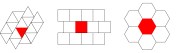
Only three regular polygons tile the plane; equilateral triangles, squares and hexagons.
As can be seen triangles and squares have strips that can slide in one direction but hexagons are fixed and unable to slide. Because of this only the hexagonal tiling is truly periodic whilst the triangular and square tilings are more properly described as non-periodic because they admit a potentially infinite number of tilings.
There is a proof that no convex polygon of more than six sides can tile the plane.
All triangles tile the plane by trivially converting to quadrilaterals, and all quadrilaterals tile the plane including concave ones .
 Quadrilaterals are the basis of lattices (translation in 2 directions)
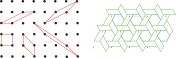
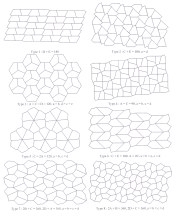
There are 14 types of convex pentagonal tiling (so far), but no proof that this is the total number possible. Each type is assumed to have corners A, B, C, D and E with edges a, b, c, d and e with edge a being between corners E and A etc.
With the exception of Type 14, each type is really a small family of shapes that satisfy the specified angular and edge restraints. Type 14 is a unique shape, in that all its angles are determined and all its edges are in fixed ratio.
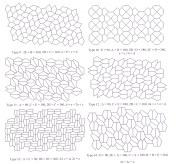
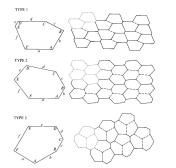
There are just 3 types of convex hexagonal tiling, with the following specifications:-
Type 1: A + B + C = 180°, a = d
Type 2: A + B + D = 360°, a = d, c = e
Type 3: A = C = E = 120°, a = b, c = d, e = f
This is the Conway Criterion for general polygonal periodic tiling without reflection
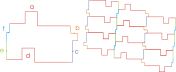
Two opposite edges a and d are parallel, congruent and in same orientation. Each of the other edges b, c, e and f are centrosymmetric (unaltered by 1800 rotation). Most architects probably have some intuitively vague knowledge of this relationship.
Non-periodic tilings tile the plane in a non-repeating manner but can also tile it in a regular periodic manner. They can be arrived at in a number of different ways:-
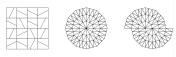 Division of Periodic Tiling Radial Displaced Radial
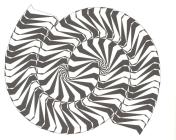
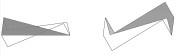 Substitution of the triangles by congruent symmetric curves can give apparently more complex tilings.
The substitution can even be 3 dimensional as here of a regular square tiling.
 Thomas Hetherwick Studio, Great Ormond Street Hospital.
Whilst these tilings are all irregular in some way they are non-periodic rather that aperiodic because they also permit a regular tiling of the plane. The triangles that make up the radial tilings for instance could also tile the plane in a periodic fashion.
Posted by Graham Shawcross
Categories: Aperiodic Tiling, Architecture, Geometry, Tiling
Tags: Aperiodic Tiling, Architecture, Geometry, Tiling
Mobile Site | Full Site
Get a free blog at WordPress.com Theme: WordPress Mobile Edition by Alex King.
[…] some guidance if you want to create your own periodic tilings. I see it called the Conway Criterion. I don’t know the field well enough to say whether that is a common term. It could be […]
LikeLike
By From my Fifth A-to-Z: Tiling (the first time) – nebusresearch on December 29, 2021 at 7:01 pm
Guys Hospital, that should read.
LikeLike
By Dan McDaniel on December 9, 2018 at 6:32 am
Hospital looks like Guys Hispital
LikeLiked by 1 person
By Dan McDaniel on December 9, 2018 at 6:31 am
[…] some guidance if you want to create your own periodic tilings. I see it called the Conway Criterion. I don’t know the field well enough to say whether that is a common term. It could be […]
LikeLike
By My 2018 Mathematics A To Z: Tiling – nebusresearch on November 30, 2018 at 7:00 pm